1. Introduction
At the United Nations Sustainable Development Summit held in September 2015, world leaders authorized the implementation of the 2030 agenda for sustainable development, which put into consideration 17 Sustainable
| [26] | UN, G. A. (2015). Transforming our world: The 2030 agenda for sustainable development. |
[26]
. Development Goals (SDGs)
| [26] | UN, G. A. (2015). Transforming our world: The 2030 agenda for sustainable development. |
[26]
. These goals aim at, but are not limited to curtailing poverty, hunger as well as inequality, supporting action on climate change, improving access to health and education, and creating healthy institutions and partnerships, over the next 15 years
| [7] | Do, M., & Kurimoto, N. (2012). Women's empowerment and choice of contraceptive methods in selected African countries. International perspectives on sexual and reproductive health, 23-33. |
[7]
. The inclusion of an impartial Goal (5) addressing gender equality, alongside gender refocusing and integration through the 16 auxiliary resolutions, is a crucial achievement of the global agenda, especially for women, by the international community
.
The sustainability development goals come in the backdrop of gender inequality, which has been a persistent challenge, with women and girls continuing to lag behind men and boys in respect to fundamental rights, opportunities and well-being worldwide
. Gender inequality hampers women and girls from realizing their full potential and by extension affects global development. Therefore, the realization of sustainable development is contingent on allowing women their legal entitlements in all occupations
| [3] | Asfaw, M. (2014). Assessment of Gender Equality in Ethiopia : The Position of Ethiopiain Women ’ s Political Representation from the World, Sub-Saharan Africa, and Eastern Africa. Journall of Law, Policy and Globalization, 28, 102–124. |
[3]
. Women are the backbone of any country, which is integral to any development and in this regard, the government should put emphasis on the abolishment of gender discrimination
| [18] | PAKISTAN, P. C. G. O. F. (2011). Framework for Economic Growth. May. |
[18]
.
According to
, devolution is the transference of rights, power, property, or responsibility to another; especially the surrender of forces to local authority by a central government. Devolution in Kenya is seen as the pillar of the 2010 Constitution, and it seeks to bring the government closer to the people by introducing County Governments. Devolution was introduced in anticipation of decentralizing some of the central government’s functions, ranging from the appropriation of political power, to the control, distribution, and re-distribution of economic resources to Kenyans at the grassroots
| [14] | Lugaga, X. O., Ondimu, K., & Adhiambo, R. A. (2015). Factors determining women’s participation in the management of co-operative societies -Njoro Sub-County, Nakuru County, Kenya. IOSR Journal Of Humanities And Social Science Ver. III, 20(9), 140–150. https://doi.org/10.9790/0837-2093140150 |
| [29] | Kenya, L. O. (2013). The constitution of Kenya: 2010 (pp. 22-29). Chief Registrar of the Judiciary. |
[14, 29]
. After decades of agitation for political pluralism and opening up of democratic space, paving the way for the formation of 47 County Governments and the National Government in Kenya
.
One of the objectives of devolution in Kenya, as stipulated in the Constitution 2010 Chapter seven, Section 81(a), is to ensure women are represented from each of the 47 counties forming the republic. The idea crowns the struggle for women’s inclusion in governance, especially in political forums and institutions, where decisions are made and resources distributed
| [9] | Frankfort-Nachmias, C., Nachmias, D., & Nachmias, D. (1992). Research methods in the social sciences. St. Martin’s Press. |
[9]
. This is in line with the global movement on empowering women to participate fully in development endeavours
| [6] | Ditlev-Simonsen, C. D., & Midttun, A. (2011). What motivates managers to pursue corporate responsibility? a survey among key stakeholders. Corporate Social Responsibility and Environmental Management, 18(1), 25–38. https://doi.org/10.1002/csr.237 |
[6]
. Women empowerment entails creating an enabling environment that enhances their capability in the decision making process, for their benefit and that of the society at large
| [7] | Do, M., & Kurimoto, N. (2012). Women's empowerment and choice of contraceptive methods in selected African countries. International perspectives on sexual and reproductive health, 23-33. |
[7]
. This is facilitated by remodeling the socio-economic, legal and political clout of women in order to ensure they enjoy their rights
.
Women participation in politics targets to increase the capacity of women to take part in, ameliorate and be in a position to reap from development in order that they can realize the weight of their contribution, respect for their dignity and be in a place to claim reasonable dissemination of the fruits of development
. Apparently, their ability to access resources is limited by discrimination and side-lining under the aegis of gender
. Participation in politics of women therefore may multiply their ability to access economic resources and opportunities, bettering their lives and those of their communities
.
In Kenya, the proportion of women who participate in politics has not increased significantly
| [4] | Chadwick, B. A., Bahr, H. M., & Albrecht, S. L. (1984). Social science research methods. Englewood Cliffs, N. J. : Prentice-Hall, c1984. https://trove.nla.gov.au/work/21853640?selectedversion=NBD23050086 |
| [1] | Agbalajobi, D. T. (2010). Women’s participation and the political process in Nigeria: Problems and prospects. African Journal of Political Science and International Relations, 4(2), 75–82. http://www.academicjournals.org/ajpsir |
[4, 1]
. It is an implication that women are grossly underrepresented, with only 17% of women in public service. The proportion of women in public service has increased by 3.8% between 2013 and 2017, but the number does not reach the threshold of a third of women in public office mark, as stipulated in the Kenyan Constitution 2010 chapter 7, Section 81(a). Apparently, sustainable progress is achieved through substantial institutional measures, policy, and more so budgetary commitment, which fix the enhancement of gender equality within policymaking
| [19] | Paxton, P., Kunovich, S., & Hughes, M. M. (2013). Gender in Politics Gender in Politics. 33(2007), 271–284. |
[19]
.
According to Mungai & Ogot (2012)
| [30] | Mungai, E. N., & Ogot, M. (2012). Gender, culture and entrepreneurship in Kenya. |
[30]
, over decades the perception of the role of girls and women has had influence on their contribution to development in Kenya. Essentially, this perception holds women from advancing development goals, particularly economic growth and food security. Women in Kenya are underrepresented in vital decision-making organs
. They also have reduced access to land, employment opportunities and education in comparison with their male counterparts. Those living in rural areas are more often than not engaged in housework, curtailing their school attendance and limiting the time they have for productivity, monetary or otherwise
| [16] | Narayanan, S., & Selvanathan, B. (2017). Challenges of Women Empowerment in. International Journal for Studies on Children, Women, Elderly And Disabled., 1(January), 90–96. https://doi.org/10.2307/2086649 |
[16]
.
Referring to the Kenyan Constitution (2010) Chapter 4, Section 59(b); there is a compelling context for addressing gender equality. This paves a way for women’s rights in Kenya; by seeking to remedy the gender inequality as well as promoting their full involvement in each aspect of growth and development
| [14] | Lugaga, X. O., Ondimu, K., & Adhiambo, R. A. (2015). Factors determining women’s participation in the management of co-operative societies -Njoro Sub-County, Nakuru County, Kenya. IOSR Journal Of Humanities And Social Science Ver. III, 20(9), 140–150. https://doi.org/10.9790/0837-2093140150 |
[14]
. When Kenyan women have acquired the opportunity to exhaust their potential, Kenyans will become stronger at family and community level
.
Kilifi County is one of the 47 counties in Kenya. According to the census done in 2009, the county had a population of 1,109,735 with over 50 percent being women
| [26] | UN, G. A. (2015). Transforming our world: The 2030 agenda for sustainable development. |
[26]
. This is to suggest that the goal of development in the county must somehow focus on women involvement and participation. However, this cannot happen effectively without including them, for they make the majority of the population.
1.1. Problem Statement
Many countries are experiencing a refinement in the indices of inclusion of various stakeholders in development around the world. This is necessitated by the Global 2030 agenda on Sustainable Development Goals (SDGs), where inclusion is a key driver of sustainability. The SDGs have reawakened the need to include women in various social spaces of development
| [22] | Schmitz, K. H., Ahmed, R. L., Troxel, A., Cheville, A., Smith, R., Lewis-Grant, L., Bryan, C. J., Williams-Smith, C. T., & Greene, Q. P. (2009). Weight Lifting in Women with Breast-Cancer–Related Lymphedema. New England Journal of Medicine, 361(7), 664–673. https://doi.org/10.1056/nejmoa0810118 |
[22]
. However, despite this emphasis in making development inclusive, gender disparities still manifest themselves in most of the developing countries
| [3] | Asfaw, M. (2014). Assessment of Gender Equality in Ethiopia : The Position of Ethiopiain Women ’ s Political Representation from the World, Sub-Saharan Africa, and Eastern Africa. Journall of Law, Policy and Globalization, 28, 102–124. |
[3]
. Indeed, gender gaps remain pervasive in access to, as well as, control over resources, economic prospects, power and political voice
.
In response to the need for inclusion of women in leadership and their participation, the drafters of the 2010 Kenyan constitution intended to fix low women participation in politics by requiring that neither gender should have less than 30% in elective and appointive positions in public service
| [29] | Kenya, L. O. (2013). The constitution of Kenya: 2010 (pp. 22-29). Chief Registrar of the Judiciary. |
[29]
. Accordingly, the enactment of the Kenya Constitution (2010) Section 59(b) has enhanced changes in the country’s governance outlay with regard to consideration for women’s inclusion in political affairs. This is necessitated by the realization that currently the proportion of Kenyan women participating in politics is barely, 17%
.
Even though the Kenyan Constitutional (2010) Section 59(b) requirement is gradually being implemented, more than eight (8) years now, minimal progress seems to have been made with regard to the attainment of the goal of women participation in politics. What remains unclear, are the factors that influence women participation in politics. It was also noted that the mechanisms to enhance women participation in politics, especially in Kilifi North sub-County also remain unexplored. It is against this background that this study was mooted to find establish out factors that influence women participation in politics and explore mechanism to enhance such participation.
1.2. Research Objectives
The study was guided by the following specific objectives:
1. To determine the level of women participation in politics in Kilifi North sub-County.
2. To establish out the influence of socio-economic factors on women participation in politics in Kilifi North sub-County.
4. Research Findings
4.1. Socio-demographic Characteristics of the Respondents
Socio-demographic characteristics refer to components of demographic and social status that distinguish and characterize individuals
| [15] | Masara, W. (n. d.). Discussing the ‘Paradigmic warfare’ informing the knowledge problem in social sciences. |
[15]
. Socio-demographics are considered essential, as these are the factors that determine the way communities conceptualize their daily lives. In this study the socio-demographic characteristics are further sub-divided into demographic information and social background characteristics of the respondents as presented next.
4.4.1. Demographic Information of the Respondents
Demographic information is critical in understanding patterns, trends and composition of the respondents. In fact, where sampling was representative, demographics can approximate the characteristics of the population from which the sample was extracted. The demographic characteristics of the respondents are presented in
Table 1.
Table 1. Demographic Information of the Respondents.
Demographics | Frequency n=116 | Percentage |
Gender | Female | 70 | 60.3% |
| Male | 46 | 39.7% |
Age | 18-34 years | 80 | 69.0% |
| 35-51 years | 28 | 24.1% |
| 51 years and Above | 8 | 6.9% |
Source: Field Data (2019).
Findings in
Table 1, shows that slightly over three-fifths (60.3%) of the respondents were females, while more than one third (39.7%) were male. The gender representation was adequate and met the Kenyan Constitution (2010) threshold where not more than two thirds should be of one gender.
Table 1 portrays interesting findings with regard to the age of respondents in the study site with over three fifths (69%) being below 35 years. This qualify as youth in the Kenyan context. However, 31% of the respondents were above 35 years. Despite this being a surprise finding, youthful society may be instrumental in transforming women participation in politics because youth can easily take risks in society. The youthfulness of the respondents may be an asset in facilitating peer-peer interventions aimed at improving the position of women.
4.1.2. Social Background Characteristics of the Respondents
Social Background characteristics are factors that relate to the social setting and the cultural dimensions of the population in the area of study. These factors are considered important in establishing the ability of people to access and control resource in the society. The social background information in the study includes marital status, religion and Level of education as presentment in
Table 2.
Table 2. Social Background Characteristics of the Respondents.
Social Background | | Frequency n=116 | Percentage |
Marital Status | Single | 44 | 37.9% |
| Married | 63 | 54.3% |
| Divorced | 2 | 1.7% |
| Separated | 2 | 1.7% |
| Widowed | 5 | 4.4% |
Religion | Christian | 68 | 58.6% |
| Muslim | 39 | 33.6% |
| Others | 9 | 7.8% |
Level of Education | No Formal education | 6 | 5.2% |
| Primary incomplete | 31 | 26.7% |
| Primary complete | 21 | 18.1% |
| Secondary incomplete | 3 | 2.6% |
| Secondary complete | 20 | 17.2% |
| Tertiary | 35 | 30.2% |
Source: Field Data (2019).
Findings in
Table 2 in regard to marital status, more than half (54.3%) of the respondents were married, over one third (37.9%) were single, while only less than one tenth (7.7%) were widowed, separated or divorced respectively. The observation that over half (54.3%) of the respondents were in marital unions is a positive finding, bearing in mind that these are women who need some experience in leadership and management. Marital status also enhance trust of these women in their work because of the integrity and respect they enjoy being in marital unions.
Results in
Table 2 also show that over half (58.6%) of the respondents interviewed were Christians, with Muslims making up over one third (33.6%), while less than one-tenth (7.8%) were African Tradition Religion adherents. The higher (58.6%) number of respondents being Christians in the sample is a mirror of Kenya, which is predominantly Christian owing to aggressive penetration of Christian evangelists and size of the Christian faith, which puts it at an advantage with regard to numbers over other faiths. This finding may have an influence on women participation in politics in the study area in line with observations by Paxton et al.
| [19] | Paxton, P., Kunovich, S., & Hughes, M. M. (2013). Gender in Politics Gender in Politics. 33(2007), 271–284. |
[19]
. that Religion is an important source of cultural beliefs in various countries. Arguments about women’s inferiority to men are present across all dominant religions, and religion has long been used to exclude women from aspects of social, political, or religious life around the world.
Finally, in
Table 2, it is evident that 5.2% of the respondents were illiterate, 44.8% had received primary level of education with only 18.1% having completed primary level of education, and 19.8% had Secondary level of education.
Additionally, only over one quarter (30.2%) had received tertiary level of education. Consequently, more than half (52.6%) of the sample had low levels of education, which could have implications on their ability to access and use information. This could have some effects on women participation in politics. In fact, these findings confirm observations made by Agbalajobi (2010), that even though women’s participation in politics has improved over the years, social perception about the leadership ability of women, their low socio-economic status, low educational and skill levels and lack of reliable role models still contribute to women’s little participation in decision-making processes.
4.1.3. Status and Nature of Employment of Respondents
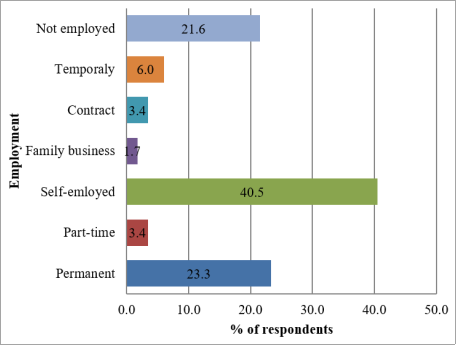
The variable employment is important because it determines an individual’s social and financial statuses, which are critical components in ensuring success in participation in political activities. From the study findings, it is clear that more than two-fifths (42.2%) of the respondents were running small businesses, such as dressmaking, small-scale farming, as well as, fishing, with less than one tenth (6%) and (6.9%) respectively attesting to operate boda boda or to being involved in seasonal jobs such as working on construction sites. The rest, accounting for more than one fifth (21.6%) and (23.3%) in either formal employment or were unemployed respectively. The nature of employment of the respondents from the diverse livelihood strategies are as shown in
Figure 1.
Figure 1. Distribution of Respondents by Nature and Employment Status.
Findings from the study shows that more than two fifths (42.2%) of the respondents were either self-employed or running family business. Over one fifth (23.3%) were permanently employed and slightly over one-tenth (12.6%) were either working on contract basis, in temporary employed or were working part-time. The remaining over one-fifth (21.6%) were not employed at all.
4.1.4. Distribution of Respondents by Income Levels
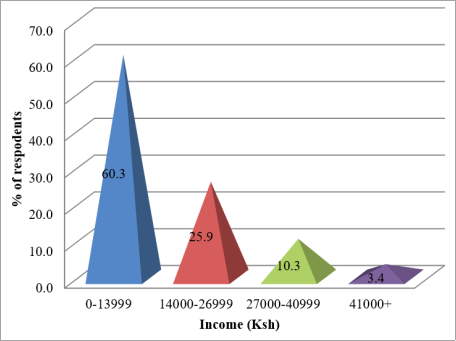
Level of income is the amount of money received from different sources by a household and on this study on a monthly basis. This variable is important in this study because it shade light on the living standard of the people, which has implications on the ability to finance the running of political campaigns and the acquisition of social positions. There is usually a direct relationship between the level of income and access to resources. The study findings in line with income levels of the respondents are as shown in
Figure 2.
From
Figure 2, it is evident that slightly over three-fifths (60.3%) of the respondents had an income of below Kshs. 14, 000.00 per month, while more than one tenth (13.7%) had an income of above Kshs. 27,000.00. Slightly over three fifths (60.3%) of the respondents, fell in the category of low-income earners. This could partially be attributed to the marginalization that exists in the region where there are not many employment opportunities for people to earn a decent living due to underdevelopment, illiteracy and poverty. Additionally, it could also be as a result of many members of the community relying on menial jobs that often do not give reasonable wage rates. The 13.7% who reported to earn above Kshs. 27,000.00 per month may represent the few who were able to obtain formal employment opportunities that are well paying.
Important to note is that the finding acknowledges the high poverty levels that exist in Kilifi North with majority of the community members unable to survive on their meagre earnings
| [21] | Sardenberg, C. (2016). Liberal vs. Liberating Empowerment: A Latin American Feminist Perspective on Conceptualising Women’s Empowerment. IDS Bulletin, 47(2). https://doi.org/10.19088/1968-2016.115 |
[21]
. More critical for this study is the fact as posed by
who alluded that access to means of production and finances have a direct relationship and influence on the participation of women in politics. It is therefore important to allow women access to employment opportunities, if we are to empower them into actively participating in public politics.
Figure 2. Distribution of Respondent’s Income Levels.
4.1.5. Influence of Ethnicity on Women Participation in Politics
Ethnicity is a group of people whose identity is based on the area of origin, which is characterized by ancestral, social, cultural as well as national experiences (Esman & Rabinovich, 2019). Ethnicity was incorporated in the study for it was included in the twentieth century as a distinguishing factor in women participation in politics. More importantly, Kilfi county is populated with varied tribes including, Giryiama, Chonyi, Duruma, Kambe, Ribe, Jibana and Digo
| [23] | Stiftung, H. B. (2008). Enhancing Women’s Political Participation 6/08. www.hbfha.com |
[23]
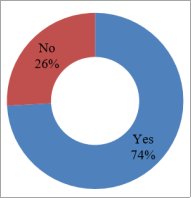
. The study sought to test whether ethnicity had influence the participation of women in politics. Results of this variable are shown in
Figure 3.
Figure 3. Effects of Ethnicity on Women Participation in Politics.
As shown by study findings in
Figure 3, nearly three quarters (74%) of the respondents felt that ethnicity had an effect on women participation in political activities. This was high, compared to over one quarter (26%) who said that ethnicity had no effect on women participation in politics. The higher (74%) number of respondents citing the influence of ethnicity is explained by the fact that the area was constituted of varied tribes. This finding supports the work of
| [9] | Frankfort-Nachmias, C., Nachmias, D., & Nachmias, D. (1992). Research methods in the social sciences. St. Martin’s Press. |
[9]
who argued that the way the society view’s women and the general perception of their place in the public arena are wide spread and acts as an obstacle for women who want public participation or even community influence. More importantly, Goetz (2004) points out that ethnicity biasness against women taking on leadership roles are also a formidable obstacle.
4.2. Women Participation in Political Activities
1. Level of Women Participation in Politics
Respondents were asked to report the levels at which women in the area of study participated in various political activities, as political aspirants, appointees or elected members holding various positions. The respondents were required to give their perceptions based on a three-point scale ranging from low to high. Ideally, having insight into these levels would enrich the enquiry with information on the situation of women participation in politics in the study area. The levels of women participation in various capacities in the area of study have been illustrated in
Table 3.
Table 3. Level of Participation of Women in Political Activities.
Political activities | Low | Moderate | High |
Vying for political seats | 58.6% | 25.9% | 15.5% |
Appointive positions in public service | 63.8% | 23.3% | 12.9% |
CDF committees | 57.8% | 25% | 17.2% |
Bursary committee | 65.5% | 24.1% | 10.4% |
Decision making in community projects | 62.9% | 25.9% | 11.2% |
Leadership within political parties | 81.7% | 12.2% | 6.1% |
Women involvement in Public forums | 47.8% | 26.1% | 26.1% |
Being chief campaigners for male candidates | 71.9% | 12.3% | 15.8% |
Affirmative action funds for women only | 34.5% | 40.5% | 25% |
Uwezo funds for women only | 37.1% | 38.8% | 24.1% |
Source: Field Data (2019).
Table 3 shows that more than half (58.6%) of the respondents rated women participation in vying for political positions as low, while less than one fifth (15.5%) rated women vying for political positions to be high. The higher (58.6%) percentage of respondents rating women participation in politics to be low is a mirror of the situation in the country. In Kilifi county there is one woman MP, 7 women representatives and 3 MCAs elected in 2017 elections. Politics is seen as a domain of men in Kenya with their number being the majority across political positions. Even the introduction of legal criteria in the Constitution 2010, not more than two thirds be of one gender in elective and appointive positions, has not been a panacea to the inequality.
The findings in
Table 3 also show that more than three fifths (63.8%) of the respondents rated women’s appointment to work in public service in Kilifi County as low, while more than one tenth (12.9%) were of the opinion that the appointment of women to work in public offices is high. The higher (63.8%) percentage who rated it as low resonates well with 1273 women workers in Kilifi County which is contributed by fact that women are not well educated and hence ill placed to compete with men in public service appointments in the county and Kenya in general.
Furthermore, over half (57.8%) of the respondents in
Table 3 felt that women involvement in CDF committees was low since 3 women are involved in CDF committee of 8 members, while 17.2% attested to the same being high. Their low involvement in CDF can be attributed to their low participation in active politics, especially campaigning for the candidates, most women participate as voters but they don’t take up active roles in campaigns, rendering them invisible and less attractive when it comes to involvement into CDF committees as politicians get rounded in pay back innuendos to their loyal campaigners, especially those who can make a big statement to their voters.
More than three fifths (65.5%) of the respondents reported in
Table 3 that women participation in Bursary committees to assist needy people was low since 4 women participate in bursary committee of 12 committee members in Kilifi County, while one tenth felt that women participation in the committees was high. Women are the custodians of households and hence well informed about educational needs of children and families. Involvement of women in bursary committee can therefore be more valuable for local development in education. The low participation of women in bursary committees registered in this study is a wakeup call suggesting a need for a deliberate attempt by the local political leadership to ensure women are strongly represented in such committees.
Moreover,
Table 3 shows that more than three fifths (62.9%) of the respondents claimed that women participation in livelihoods aimed at alleviating community needs through projects was low, while more than one tenth (11.2%) held that the level of women participation in decision making in community projects was high. Low levels of women participation in decision making with regard to community projects is not a surprise to this study for the men women ration in community projects was 7: 3 which reflects the weak position of women in development endeavours in the country and the globe. This finding has implication for reflections on innovations needed to reverse this status quo.
Even more interesting, as portrayed in
Table 3, is that more than four fifths (81.7%) of the respondents were of the opinion that women participation in leadership among political parties was low, while a small proportion (6.1%) were in contrast. Their low participation is explained by male domination in political parties attracting less attention and interests from women who wish to take part in party leadership. More importantly, seven women were included in political leadership. Women will be more attracted and motivated to participate fully when the political environment is improved to be accommodative of their needs and aspirations in society.
Findings in
Table 3 further depict that over two fifths (47.8%) of the respondents indicated low participation of women in public forums, as compared to more than one quarter (26.1%) of the respondents, who reported high participation of women in public forums discussing matters of societal development. The disparity in percentages with low participation of women is reflective of the situation on the ground. Their low participation is due to long time exclusion based on marginalization and their exclusion in formal schooling and barriers of culture and tradition which do not create spaces for free and unbiased women engagements.
The study also shows that over three fifths (71.9%) of the respondents claimed that involvement of women as chief campaigners for male candidates was low, while more than one tenth (15.8%) reported it as being high. As observed earlier, political campaign in Kenya involve aggressive activities and sometimes violence. These attributes makes political involvement for women less attractive because of their socialization in mostly patriarchal communities. In these communities division of labour is clear with women being encouraged to participate in less or non-violent activities than their male counterparts.
Additionally, more than one third (34.5%) of the respondents indicated that women participation in affirmative action funds was low, while one quarter (25%) said it is high. This discrepancy may probably be explained by lack of information among women on the existence of these opportunities, given that most women have low literacy levels as shown in this study earlier. Literacy levels are critical for access and use of information including that of taking advantage of the affirmative funds to empower themselves.
Table 3 also shows that over one third (37.1%) of the respondents reported women participation in Uwezo funds meant for the improvement of women economic welfare to be low, while more than three fifths (62.9%) reported moderate to high participation of women in the utilization of the funds. This finding contradicts the above finding which revealed that women participation in affirmative funds is low (34.5%), while more than three-fifths (62.9%) reported moderate to high participation of women in the utilization of Uwezo funds. This contradiction may be explained by the fact that affirmative funds are a political kit, which may most likely benefit more supporters on an incumbent politician (Women Representative) than her opponents, while Uwezo funds are non-political and hence accessible for all women.
Finally,
Table 3 shows that women participation in various political activities in the study area is low, with more than half (51%) of the respondents rating low women participation in political activities. The findings confirm the observation of
| [1] | Agbalajobi, D. T. (2010). Women’s participation and the political process in Nigeria: Problems and prospects. African Journal of Political Science and International Relations, 4(2), 75–82. http://www.academicjournals.org/ajpsir |
[1]
that the proportion of women in Kenya who participate in various political activities is dismal and it has not increased significantly over the years. This implies that women are grossly underrepresented in various political activities. The World Economic Forum (2016)
adds that Kenya lags behind in various sub-indexes of gender equality and women’s historical experience of discrimination puts them at a disadvantaged position politically. The Social and economic status of women to a great extent play a significant role in enhancing their participation, as well as, representation in political activities.
2. Challenges Women Face when they Vie for Political Positions
In Kenya, there is a myth and misconception on the place of women in the community and it has been persistent over time
| [17] | Of, C., World, T. H. E., Together, C., Face, T. O., & Future, T. H. E. (n. d.). No Title. |
[17]
. This has caused women to be despised by male leaders thus discriminated upon leading to low support from men in politics probably due to male chauvinism and fear of men losing their positions in the community. Field observation reveals that some women are afraid to vie because of strong male competition, which was attributed to women’s low levels of education and overload of family issues. Other reasons were cited as finance limitations, gender discrimination and harassment.
The study further revealed that there was lack of transparency and accountability in many political activities. Increasing corruption was cited as a factor that is multiplying the lack of trust and support for women candidates from even their female colleagues.
This in addition to patriarchal marriages makes women become confined at home, where they have low influence on decision making, as well as, encountering resistance from their husbands. From the participants point of view religion and culture were to blame for this state of affairs on women decimal participation in politics. Lack of access and power to use common resources in the home was also seen as a factor hindering women active participation in politics. Study findings also revealed a shortfall in the number of institutions mandated with enacting laws or implementing them in order to enhance women participation in leadership and governance.
3. Bivariate analysis of influence socio-economic factors on women participation in politics
Various statistical tools used in this work helped provide the true position on the relationship that exists between the dependent and independent variables. Bivariate analysis using Chi-square statistic for the test of significance (goodness of fit) and Cross-tabulation was used to examine the influence of socio-economic factors (independent variable) of the study on women participation in politics, the dependent variable. The Chi-square statistic is calculated as follows:
Where is the Chi-square statistic, O is the observed Frequency and E ids the expected frequency.
Additionally, this thesis uses the Cramer’s V to provide a measure of influence between the study variables. The rationale behind Cramer’s V is that it is appropriate in showing the strength of association between variables of a study. The Crammer’s V is calculated as follows:
Where “n” is the sample size; χ2 is the Chi-square statistic and “m” is the smaller of (rows-1) or (columns-1). The maximum value of V is 1, whereby the more unequal/ the marginal, the more V will be less than 1.0.
The analysis in this work was done using the Statistical Package for social Sciences (SPSS) Version 21.0 and the test are carried out at Sigma 0.05.
4. The Influence of Socio-Economic Factors on Women Participation in Political Activities
In the series of bivariate analysis, using Chi-square, several socio-economic characteristics were tested for their influence on women participation in political activities. Results of study based on Chi-square statistics for each independent variable and dependent variable have been presented, interpreted and discussed. Discussion of findings of analysis was done to integrate the results within the existing body of knowledge. The Chi-square statistics analyses for the socio-economic factors (independent variable (s)) and women participation in politics (dependent variable) are presented in
Table 4.
Table 4. The Influence of Socio-Economic Factors on Women Participation in Political Activities.
| Vying for Political Seats | Appointive Positions | Political Party Leadership | Public Forums |
χ2 | Df | P | χ2 | df | P | χ2 | df | P | χ2 | df | p |
Gender | 1.810 | 1 | 0.179 | 1.347 | 1 | 0.246 | 1.256 | 1 | 0.262 | 3.143 | 1 | 0.076 |
Marital status | 5.901 | 1 | 0.015** | 0.0071 | 1 | 0.935 | 2.775 | 1 | 0.097 | 0.880 | 1 | 0.348 |
Age | 6.849 | 2 | 0.032* | 1.614 | 2 | 0.446 | 6.046 | 2 | 0.049* | 3.352 | 2 | 0.187 |
Education level | 3.218 | 1 | 0.073 | 8.025 | 1 | 0.005** | 0.057 | 1 | 0.811 | 3.279 | 1 | 0.070 |
Religion | 1.080 | 1 | 0.299 | 0.460 | 1 | 0.498 | 0.569 | 1 | 0.451 | 0.007 | 1 | 0.935 |
Income level | 2.501 | 2 | 0.286 | 2.947 | 2 | 0.229 | 3.758 | 2 | 0.153 | 0.528 | 2 | 0.768 |
Nature of employment | 1.514 | 2 | 0.469 | 2.414 | 2 | 0.299 | 1.418 | 2 | 0.492 | 1.632 | 2 | 0.442 |
Ethnicity | 1.419 | 1 | 0.234 | 5.241 | 1 | 0.022* | 0.406 | 1 | 0..524 | 0.734 | 1 | 0.392 |
Source: Field Data (2019). Key: * Significant at 0.05 ** Significant at both 0.05 & 0.01.
Overall, gender did not significantly influence women participation in vying for political seats such as Presidency, Governorship and Member of Parliament (χ2=1.810; df=1; p =0.179), participation in appointive position such as in CDF committees (χ2=1.347; df=1; p =0.246) and political party leadership (χ2=1.256; df=1; p =0.262). Moreover, gender did not significantly influence the women participation in public forums (χ2=3.143; df=1; p =0.076). Contrary to the observations of
| [6] | Ditlev-Simonsen, C. D., & Midttun, A. (2011). What motivates managers to pursue corporate responsibility? a survey among key stakeholders. Corporate Social Responsibility and Environmental Management, 18(1), 25–38. https://doi.org/10.1002/csr.237 |
[6]
that in African cultures men are given higher opportunities in matters parting leadership. As noted by
the exclusion of women in different arena influences their participation in politics thus limiting their public life.
Results in
Table 4 show that marital status did not significantly influence women participation in appointive positions, political party leadership and public forums. However, marital status was found to be statistically significant in influencing women participation in vying for political seats (χ2=5.901; df=1; p =0.032). This finding supports ILO (2016)
observation that when a woman declares interest in politics the society traces the family background of the candidate and their responsibility in the family. In 1992, 1997, 2002 and 2007 women faced political discrimination and in other cases they were affronted who was taking care of their homes while they were attending to political roles
| [23] | Stiftung, H. B. (2008). Enhancing Women’s Political Participation 6/08. www.hbfha.com |
[23]
.
Findings in
Table 4 also reveal that age significantly influence women vying for political seats (χ2=849; df = 2; p=0.032), as well as, in women leadership within the political parties (χ2=6.046; df = 2; p=0.049). Indeed, age was significantly associated with women leadership both in public and within the political parties such as ODM, UDA, URP, PNU, KANU, CCM, UCP and many more.
As observed earlier over three-fifths (69%) being below 35 years portraying the youthful of the population sampled. These finding supports those of
| [7] | Do, M., & Kurimoto, N. (2012). Women's empowerment and choice of contraceptive methods in selected African countries. International perspectives on sexual and reproductive health, 23-33. |
[7]
which alluded that the promotion of women participation in leadership and decision-making should be insulted at young age, which will translate to later application in adult age. Sardwenberg (2016)
| [21] | Sardenberg, C. (2016). Liberal vs. Liberating Empowerment: A Latin American Feminist Perspective on Conceptualising Women’s Empowerment. IDS Bulletin, 47(2). https://doi.org/10.19088/1968-2016.115 |
[21]
and Wekwete (2014)
| [27] | Wekwete, N. N. (2014). Gender and Economic Empowerment in Africa: Evidence and Policy. Journal of African Economies, 23(suppl 1), 87–125. https://doi.org/10.1093/jae/ejt022 |
[27]
emphasises on the institutionalization of socialization to enhance equal treatment of both genders for family is considered as a basic agent of socialization and passing of decision-making roles in the society.
Additionally,
Table 4 above shows that the education levels of women significantly influence their participation in appointive positions such as working in public service, taking part in CDF committees and regulation of affirmative action funds (χ2=8.025; df = 1; p=0.005). Furthermore, the study findings unearthed that education levels did not significantly influence women vying for political seats (χ2=3.218; df = 1; p=0.073) as well as their participation in public forums (χ2=3.279; df = 1; p=0.070). This finding is in tandem with statistics in
| [27] | Wekwete, N. N. (2014). Gender and Economic Empowerment in Africa: Evidence and Policy. Journal of African Economies, 23(suppl 1), 87–125. https://doi.org/10.1093/jae/ejt022 |
[27]
and confirms those of Agbalajobi (2014) and British Council (2016)
that posited that there is a relation between level of education and women participation in politics. In fact,
| [2] | Allan, K. (2006). Contemporary social and sociological theory : visualizing social worlds. Pine Forge Press. |
[2]
adds that the women’s level of education, skill level and experience is a key determinant of their socio-economic status.
Finally, study findings as illustrated in
Table 4 show that ethnicity significantly influenced women participation in appointive positions (χ2=5.241; df = 1; p=0.022). However, ethnicity did not significantly influence women vying for political seats, leadership within political parties and participation in public forums. The finding supports the observation of
| [14] | Lugaga, X. O., Ondimu, K., & Adhiambo, R. A. (2015). Factors determining women’s participation in the management of co-operative societies -Njoro Sub-County, Nakuru County, Kenya. IOSR Journal Of Humanities And Social Science Ver. III, 20(9), 140–150. https://doi.org/10.9790/0837-2093140150 |
[14]
that there is low women uptake on leadership roles because of their acceptance of the gendered division of labour, which is highly influenced by the tribe as a deciding factor. More importantly Randal, et al. (2012)
| [31] | Randal, C., Pratt, D., & Bucci, S. (2015). Mindfulness and self-esteem: a systematic review. Mindfulness, 6, 1366-1378. |
[31]
points out that the imbalance between public life and their family chores affects the political progression and some ends up resigning from their public positions.
5. Multivariate Analysis of Socio-Economic Factors on Women Participation In Politics
The main objective of the study was to assess the factors (socio-economic and quotas) that influence participation of women in politics. The variable politics was operationalized into four indicators namely; vying for political seat, appointive positions, leadership within political parties and public forums. Thus, the study sought to synergize the indices into a binary (1: low, 2: High) variables by which participation in politics could be understood and multivariate analysis computed. Subsequently the variables were transformed into either low participation for those household below the set standard, or high participation for those households that met the minimum standard for vying for political seats, appointive positions, party leadership and participation in public forums. The study findings revealed that 52% of the households fell into low, while 48% fell into high participation respectively. Multiple Regression analysis is then computed between the independent variables of the study and the dependent variable based on the new binary (Low & High) classification.
6. Influence of Socio-Economic Factors on Women Participation in Politics
One of the specific objectives of the study was to assess the influence of socio-economic factors on the level of women participation in politics in Kilifi North sub-County. Socio-economic factors were considered in the study because of their potential as barriers to women participation in politics. Results of the analysis of socio-economic factors in relation to women participation in politics are presented in
Table 5.
Table 5. Influence of Socio-Economic Factors on Women Participation in Politics.
Variable | χ2 | Df | P-value | Cramer’s V |
Gender | 1.881 | 1 | 0.170 | 0.127 |
Marital status | 7.772 | 1 | 0.005** | 0.259 |
Age | 5.613 | 2 | 0.060 | 0.220 |
Education level | 5.506 | 1 | 0.019** | 0.218 |
Religion | 0.237 | 1 | 0.626 | 0,045 |
Income level | 2.300 | 2 | 0.137 | 0.141 |
Nature of employment | 3,755 | 2 | 0.153 | 0.180 |
Ethnicity | 0.153 | 1 | 0.695 | 0.036 |
Source: Field Data (2019). Key: * Significant at 0.05, ** Significant at both 0.05 & 0.01.
Results in
Table 5 show that gender was not significant in influencing women participation in politics. The relationship between gender and women participation in politics was not significant (χ2=1.881 df =1 P=0.170 Cramer’s V=.191). This was a surprise to the study because the assumption was that being a woman limits the opportunities of participation in politics, compared to men.
The lack of significance might have been caused by the involvement of men in the study who might have balanced this view in their own favour. Interesting observation was that when women were asked about their preference for a leader, four fifths (80.0%) said they would prefer electing a woman to participate in politics. However, the finding was in line with that of Wekwete, (2014)
| [27] | Wekwete, N. N. (2014). Gender and Economic Empowerment in Africa: Evidence and Policy. Journal of African Economies, 23(suppl 1), 87–125. https://doi.org/10.1093/jae/ejt022 |
[27]
who noted that socialization of children to expect and accept different parts in life has created a social mechanism for the development of values that engender the several forms of discrimination against females. The International Labour Organization (ILO 2016) adds that excellent psychological weapon available to men is the length of time over which they have enjoyed dominance over women, who have taken it for granted, especially in the area of politics. In this area men are seen to continue to stereotype women and justify their subordination based on gender roles in the society
| [18] | PAKISTAN, P. C. G. O. F. (2011). Framework for Economic Growth. May. |
[18]
.
Findings in
Table 5 further reveal that more than half (54.3%) of the respondents were married. Women who are married are shown to have high preferences for participation in politics. The study shows that marital status influence women participation in politics by 25.9%. Indeed, marital status had a significant influence on women participation in politics (χ2=7.772; df = 1; p=0.005; which is a moderately strong relationship as per the Cramer’s V= 0.259) test results. The finding corroborates the observation by Sardenberg (2016)
| [21] | Sardenberg, C. (2016). Liberal vs. Liberating Empowerment: A Latin American Feminist Perspective on Conceptualising Women’s Empowerment. IDS Bulletin, 47(2). https://doi.org/10.19088/1968-2016.115 |
[21]
& Wekwete (2014)
| [27] | Wekwete, N. N. (2014). Gender and Economic Empowerment in Africa: Evidence and Policy. Journal of African Economies, 23(suppl 1), 87–125. https://doi.org/10.1093/jae/ejt022 |
[27]
, who showed that continued uneven distribution of family care responsibilities means that women spend far more time than men at home and in caring for children. This demonstrate that women pay a “motherhood penalty,” across fields relating not just to the time, effort, and medical care of pregnancy and childbirth, but to the far more significant maternal involvement necessary for breastfeeding, and to the persistent tendency of women to do a more substantial share of childcare as the child grows. This continued unequal distribution of home chores limits women ability to vie for various political seats as indicated by Upadhyay, et al., (2012)
| [25] | Upadhyay, U. D., Karasek, D., International, S., Health, R., & June, N. (2016). Women ’ s Empowerment and Ideal Family Size : An Examination of DHS Empowerment Measures In Sub-Saharan Africa Linked references are available on JSTOR for this article : Women ’ s Empowerment and Ideal Family Size: An Examination of DHS Empowerment Meas. 38(2), 78–89. https://doi.org/10.1363/3807812 |
[25]
.
Table 5 further depicts that more than three fifths (69%) of the respondents were youths, showing potential leadership in the society. In this study age was not a significant influencer women participation in politics (χ2=5.613 df =2 P=0.060 Cramer’s V= 0.220). The findings contradicts those of Wekwete (2014)
| [27] | Wekwete, N. N. (2014). Gender and Economic Empowerment in Africa: Evidence and Policy. Journal of African Economies, 23(suppl 1), 87–125. https://doi.org/10.1093/jae/ejt022 |
[27]
that in most African cultures, men are viewed as natural born leaders and the socialization of the girl child in several societies is additionally to blame for the perceived inabilities on the part of women. We discover that from a young age, women are educated to be smart home manufacturers and to not be smart leaders contrary to the male counter-parts
. However, this is often slowly dynamical in the higher perception with the girl child perpetually being told that she will be able to win something that she sets her mind on (Upadhyay, et al., 2012).
Finally,
Table 5 also reveals that the education level of women was found to be statistically significant in influencing their participation in politics. The finding reveals that education influences women participation in politics by 21.8% (χ2=5.506; df = 1; p=0.019; Cramer’s V=0.218). Agbalajobi, (2010) observed that women’s political representation has improved over the years, social perceptions about the leadership ability of women, their low educational and skill levels and lack of reliable role models still contribute to women’s little participation in decision-making processes. The findings were in contract with British Council (2016) report that observed that women education level has improved over yeas and did not affect women participation in politics. The reported further indicated that low women participation in politics is contributed by the Women’s historical experience of discrimination, which puts them at a disadvantaged position economically. Cheng et al., (2010) added that social and economic status of women to a great extent play a significant role in enhancing their participation as well as representation in political decision-making bodies in Africa. In this study, level of education is seen as a contributing factor to women participation in politics and recognises the tremendous improvement in women’s education due to its ability to determine the social status of women, which in turn influences their capability to participate in politics.





 Share This Article
 Twitter
 Linked In
 Facebook
 Copy
Copy Download